0800 233 725 (toll-free)
 enquiries@online.tut.ac.za
%201.png?width=371&height=115&name=logo%20(1)%201.png)

The global tourism and hospitality landscape has evolved into a highly competitive, complex sector that demands resilient, adaptive management. In South Africa, where tourism drives regional economic development and rural upliftment, the demand for sophisticated executive leadership is escalating. To bridge this professional competency gap, the online division of the Tshwane University of Technology (TUT) offers a fully online Master of Tourism and Hospitality Leadership. This NQF Level 9 programme comprises 14 modules totalling 180 credits and is structured to be completed over a flexible two-year timeline. Because of the advanced analytical and research-intensive demands of this postgraduate qualification, prospective candidates must meet a clear set of academic, technical, and administrative entry requirements.
Academic Admission Criteria and Articulation Pathways
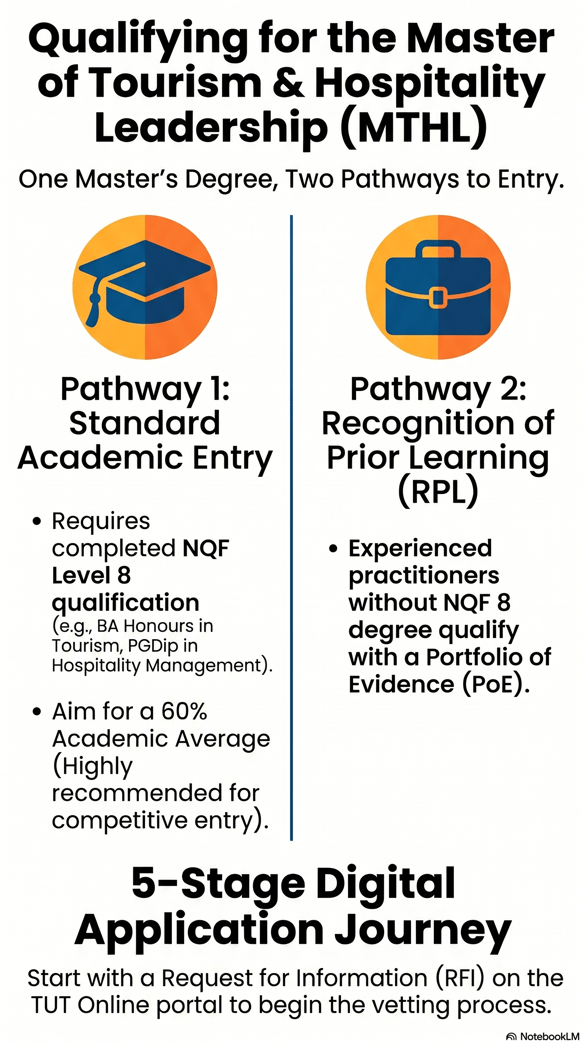
Standard admission to the Master of Tourism and Hospitality Leadership requires a completed NQF Level 8 qualification in a related discipline. To ensure that students possess the foundational business acumen and analytical skills necessary to engage with complex financial, marketing, and leadership modules, the university accepts specific academic qualifications.
To support academic progression and professional mobility, the university admits candidates holding an Honours degree or a Postgraduate Diploma in specific sub-fields. To prepare students for the rigorous coursework and independent research required at this level, it is highly recommended that applicants have achieved a minimum academic average of 60% in their previous studies. While falling below this average does not automatically disqualify an applicant, candidates with stronger academic records are given priority, particularly if a specific cohort intake is highly competitive or oversubscribed.
Approved Academic Qualifications and Benchmarks
- Bachelor of Arts Honours in Tourism or Tourism Management
- Bachelor of Business Administration Honours in Hospitality Business Strategy
- Postgraduate Diploma in Hospitality Management or Recreation and Tourism
- Cognate Honours Degree in a closely related business, administration, or management discipline
Alternative Admission via Recognition of Prior Learning
For experienced industry practitioners and executives who have developed significant workplace expertise but lack formal NQF Level 8 academic credentials, the university provides an alternative access route through its Recognition of Prior Learning (RPL) policy. This pathway allows career progression by validating knowledge acquired through professional practice, short courses and in-service training.
Under the RPL framework, candidates may apply for alternative access, module exemptions, or credit transfers. Candidates seeking alternative access must submit a comprehensive portfolio of evidence demonstrating cognitive and managerial competencies equivalent to an NQF Level 8 standard.
The Multi-Stage Digital Vetting and Application Journey
To accommodate the schedules of working professionals, the university uses a streamlined, fully digital five-step application journey. This structured process is designed to evaluate student eligibility thoroughly before a candidate formally applies, avoiding unnecessary delays or administrative friction.
The application journey begins when a prospective student completes a Request Information form. Following this submission, an enrolment specialist conducts a preliminary assessment of the applicant's academic and professional background. If the applicant meets the eligibility criteria, they receive a link to complete the formal application and upload certified documents. A dedicated academic team reviews the documents to make a final admission decision. Once accepted, the student is issued a unique student number to facilitate module registration and gain access to the virtual learning environment.
The Five-Stage Digital Application Journey
- Stage 1 - Enquiry: The candidate completes the online Request Information form, prompting the institution to create the initial candidate record and assign a dedicated enrolment specialist.
- Stage 2 - Consultation: The candidate participates in an advising call to discuss professional goals and academic history, during which the institution verifies their NQF Level 8 status and reviews standard admission requirements.
- Stage 3 - Submission: The candidate completes the digital application form via the received personalised link, and the institution logs the application with no fee charged for online programmes.
- Stage 4 - Documentation: The candidate uploads certified digital copies of identity documents, academic transcripts, and certificates, which the institutional admissions team then evaluates through a comprehensive review of transcripts and credentials.
- Stage 5 - Integration: The candidate receives their official acceptance letter and sets up their digital student portal account, while the institution issues a unique student number and onboards them to the virtual Learning Management System (LMS).
Technical Requirements and Study Commitments for Online Success
While the asynchronous online format offers flexibility, it requires a high degree of self-discipline and specific technical capabilities. Because there are no real-time lectures, students must proactively manage their time and be prepared to allocate between 10 and 15 hours per week to their studies. This time is typically divided among reading academic literature, participating in interactive discussions, preparing research reports, and completing continuous online assessments.
To participate in the programme, students must possess a reliable laptop or desktop computer and a stable, high-speed internet connection. Intermediate computer literacy is essential for navigating the Learning Management System (LMS), uploading assignments, and conducting online research.
Administrative and Financial Frameworks
Managing the administrative and financial aspects of postgraduate study is simplified through the online division's student-centred policies. The programme does not charge an application fee, eliminating immediate barriers to entry.
Financially, the programme is structured around a flexible pay-per-module framework, enabling students to pay only for the modules they register for in a given term. This model allows working professionals to self-fund their education sequentially, aligning their tuition payments with their monthly income and cash flow. Additionally, the online programme offers six starting dates throughout the year. This multiple-intake model ensures that if an applicant misses a registration deadline, they only experience a delay of about two months before the next opportunity to begin their studies, rather than waiting an entire academic year.
Read further about the programme
If you would like to find out more about the Master of Tourism and Hospitality Leadership programme, you can also read the following articles:
- What careers require a Master of Tourism and Hospitality Leadership?
- TUT Master of Tourism and Hospitality Leadership Application Guide
- How TUT's online Master of Tourism and Hospitality Leadership works
FAQs
1. What standard NQF Level 8 qualifications are required for direct entry into the programme?
To gain direct admission, an applicant must hold an NQF Level 8 qualification from an accredited institution, specifically a Bachelor of Arts Honours in Tourism, a Bachelor of Arts Honours in Tourism Management, a Bachelor of Business Administration Honours in Hospitality Business Strategy, or a Postgraduate Diploma in Hospitality Management or Recreation and Tourism. Candidates with a four-year professional Bachelor's degree or an Honours degree in a closely related cognate field may also qualify, subject to academic and departmental review.
2. How can candidates without a standard NQF Level 8 qualification gain admission?
Prospective students who have extensive professional experience but do not possess standard NQF Level 8 credentials can apply for alternative entry through the Recognition of Prior Learning (RPL) framework. Candidates must submit a detailed portfolio of evidence containing a comprehensive CV, verified proof of workplace expertise, employer testimonials, and records of non-formal or informal training. This portfolio must demonstrate that the applicant has developed cognitive and strategic competencies equivalent to an NQF Level 8 standard.
3. What is the preliminary vetting process to check if an applicant qualifies?
Rather than submitting a formal application immediately, prospective students begin by filling out a Request Information form. This preliminary step initiates a consultation with an enrolment specialist who evaluates the candidate's academic transcripts, NQF levels, and professional background. If the applicant meets the necessary requirements, they receive a personalised digital link to complete the formal application and upload their certified documents.
4. What supporting documentation is required to complete the application process?
Applicants must provide certified digital copies of their South African Identity Document or valid international passport, complete academic transcripts, and final graduation certificates for all completed tertiary qualifications. International applicants must also provide official English translations of their transcripts if applicable, along with a Certificate of Evaluation from the South African Qualifications Authority (SAQA).
5. How does the evaluation of foreign qualifications work for international applicants?
International students who completed prior studies outside of South Africa must apply to SAQA for a Certificate of Evaluation. This certificate authenticates the foreign qualification and establishes its exact equivalent level within the South African National Qualifications Framework. Because SAQA's evaluation process typically takes about 30 working days to complete, international candidates are advised to initiate this step well before their intended programme intake deadline.