0800 233 725 (toll-free)
 enquiries@online.tut.ac.za
%201.png?width=371&height=115&name=logo%20(1)%201.png)

The Master of Management Sciences in Contact Centre Management, offered fully online by the Tshwane University of Technology (TUT), is an NQF Level 9 qualification totalling 180 credits. Designed to develop a high level of academic engagement applicable to the contact centre environment, the degree is delivered fully online and asynchronously to accommodate working professionals. The following sections detail the specific academic, procedural, and administrative requirements for entry.
1. Academic Entry Prerequisites
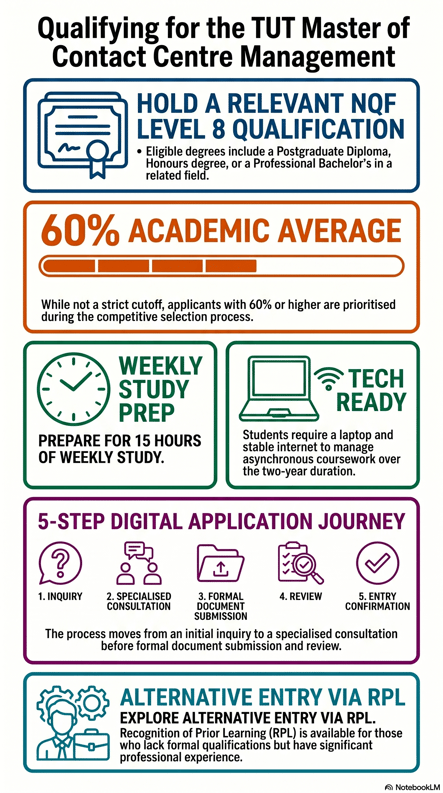
Admission into the online programme is competitive and based primarily on an applicant’s academic performance in their previous qualifications. Applicants must hold a relevant NQF Level 8 qualification to be considered for the programme.
Eligible qualifications include:
- Postgraduate Diploma: A Postgraduate Diploma in Contact Centre Management or an equivalent NQF Level 8 qualification such as a Postgraduate Diploma in Marketing Management.
- Honours Degree: A relevant Honours degree in a related field.
- Professional Bachelor’s Degree: A professional Bachelor's degree at NQF Level 8.
It is further advised that applicants achieve a minimum average of 60% in their previous NQF Level 8 qualification. This will ensure that applicants are suitably prepared to handle the academic rigour of the qualification. While failure to have achieved this will not automatically disqualify your application, candidates with better marks will be accepted first, and you may not be accepted if that particular intake is oversubscribed.
2. Technical and Study Commitment Requirements
Because the program is delivered through a Learning Management System (LMS) with no real-time lectures, students must meet specific technical and personal commitment criteria.
- Hardware and Connectivity: Students must have access to a laptop or desktop computer and a stable internet connection.
- Time Commitment: Applicants must be prepared to commit 10-15 hours per week to their studies to manage coursework and research components effectively.
- Duration: The standard duration to complete the advanced coursework and the required research project is two years.
3. The Multi-Stage Application Process
TUT Online utilises a structured, five-step application journey to evaluate eligibility and guide prospective students through registration.
- Expression of Interest: Prospective students complete the "Request for Information" form found on the programme page.
- Consultation: A specialised TUT agent contacts the applicant to discuss the program and verify if they meet the entry requirements.
- Application Link: If the applicant is found eligible, they receive a personalised link to complete the formal application and upload documents.
- Academic Review: A dedicated team reviews the submission and documents to make a final decision.
- Official Acceptance: Successful applicants receive an official acceptance letter and guidance on setting up student accounts and accessing the LMS.
Required Documentation
No student is admitted to any qualification without a prior evaluation of their documentation. All required documents must be certified and accompany the online application.
|
Document Category |
Specific Requirements |
|
Proof of Identity |
A certified copy of the applicant’s Identity Document (ID) or Passport. |
|
Academic Records |
Certified copies of previous qualifications and official academic transcripts. |
|
Foreign Qualifications |
Qualifications obtained outside South Africa must be accompanied by a certificate of equivalence from SAQA. You can apply for this here. |
Alternative Entry: RPL
TUT provides alternative pathways for admission for candidates who may not strictly comply with formal academic requirements through its Recognition of Prior Learning (RPL) policy. RPL may be applied for access to modules, credits from modules, and credits towards or for the qualification.
RPL for access:
Learners who do not meet the minimum entrance requirements or the required qualification at the same NQF level as the qualification required for admission may be considered for admission through RPL.
To be considered for admission in the qualification based on RPL, applicants should provide evidence in the form of a portfolio that demonstrates that they have acquired the relevant knowledge, skills, and competencies through formal, non-formal and/or informal learning to cope with the qualification.
RPL for exemption of modules:
Learners may apply for RPL to be exempted from modules that form part of the qualification. For a learner to be exempted from a module, the learner needs to provide sufficient evidence in the form of a portfolio that demonstrates that competency was achieved for the learning outcomes that are equivalent to the learning outcomes of the module.
RPL for credit:
Learners may also apply for RPL for credit towards the qualification, in which they must provide evidence in the form of a portfolio demonstrating prior learning through formal, non-formal and/or informal learning.
International Students
If your previous qualifications were obtained outside of South Africa, you must provide a Certificate of Evaluation from the South African Qualifications Authority (SAQA). The standard turnaround time for SAQA is approximately 30 working days, so this process should be initiated well in advance of the university intake deadline. You can apply for this here.
Further reading about this programme
If you would like to find out more about the Master of Management Sciences in Contact Centre Management programme, you can also read the following articles: