0800 233 725 (toll-free)
 enquiries@online.tut.ac.za
%201.png?width=371&height=115&name=logo%20(1)%201.png)

The global tourism and hospitality sector requires highly strategic, ethical, and adaptive leadership capable of navigating complex economic fluctuations, environmental pressures, and dynamic regulatory frameworks. To address this demand, the Tshwane University of Technology offers its fully online Master of Tourism and Hospitality Leadership programme. This NQF Level 9 qualification provides a flexible, asynchronous environment tailored for working professionals seeking senior administrative, consulting, or executive roles. Unlike traditional campus admissions, the online division utilises a highly supported and structured digital pipeline to guide candidates seamlessly from initial enquiry to formal onboarding.
Academic Admission Criteria and Articulation Pathways
Securing admission into this 180-credit postgraduate programme requires a solid academic foundation at NQF Level 8. Candidates must possess a Bachelor of Arts Honours in Tourism, a Bachelor of Arts Honours in Tourism Management, a Bachelor of Business Administration Honours in Hospitality Business Strategy, or a Postgraduate Diploma in Hospitality Management or Recreation and Tourism. This strict requirement ensures that incoming candidates possess the advanced theoretical foundation necessary to engage with complex, research-intensive modules, specifically the 60-credit Research Project stream.
For candidates with extensive industry leadership experience but lacking formal NQF Level 8 qualifications, the university has an approved Recognition of Prior Learning (RPL) policy. Under this framework, RPL for Access serves as an alternative entry point. Applicants must submit a comprehensive Portfolio of Evidence containing employment history, testimonials, and work projects. This allows the academic committee to assess whether the applicant's informal or non-formal learning equates to the required cognitive tools, bridging the gap between lived corporate experience and academic rigour.
You can read more details on the entry criteria and RPL process in this article.
The Five-Stage Digital Application Pipeline
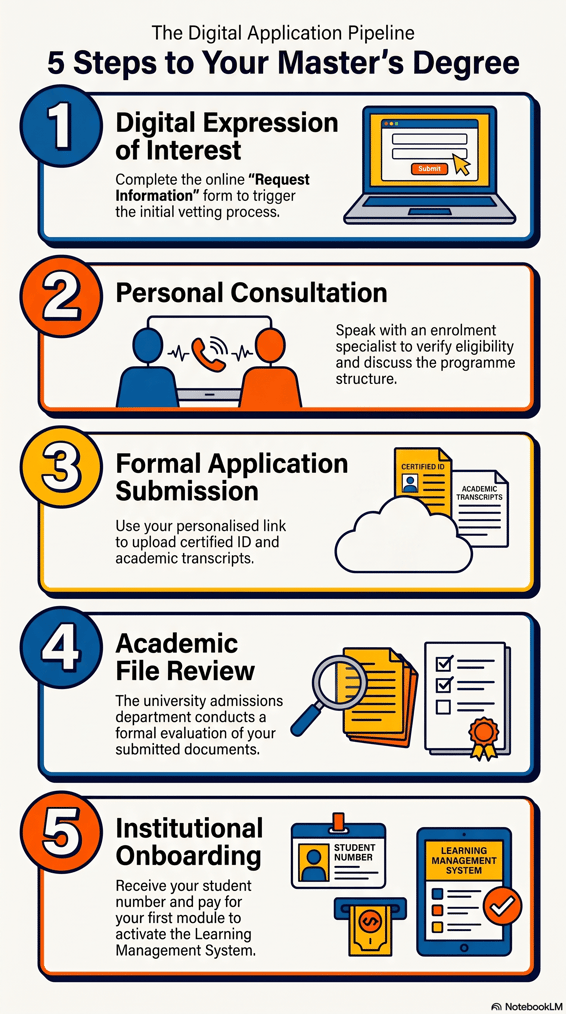
The application framework for the online division is structured to be entirely digital, supportive, and streamlined to prevent administrative delays. The pipeline consists of five key steps:
- Step 1: Digital Expression of Interest
- The process begins when the candidate completes the Request Information form online. This registers the applicant's profile and triggers the initial screening and vetting process.
- Step 2: Personal Consultation
- A dedicated enrolment specialist contacts the candidate to verify academic eligibility, explain the pay-per-module financial structure, and discuss online study workloads.
- Step 3: Formal Application Submission
- If the candidate meets the admission criteria during the consultation, the university emails a private, personalised application link. The applicant completes the digital form and uploads certified copies of all supporting academic credentials and identity documents.
- Step 4: Academic File Review
- The university admissions department conducts an analytical evaluation of the submitted file, verifying academic transcripts, the relevance of previous qualifications, and overall document completeness.
- Step 5: Institutional Onboarding
- Successful candidates receive an official electronic letter of admission containing a unique student number, which facilitates module payment, student email setup, and access to the virtual Learning Management System (LMS).
Post-Submission Outcomes and System Parameters
Unlike traditional programmes that charge processing fees, the online division has no application fee. The financial model operates on a pay-as-you-go system, requiring payment only for the specific active module prior to its registration deadline. Multiple start dates throughout the calendar year allow professionals to begin their studies during specific periods, minimising the career opportunity cost of missing traditional annual deadlines. Once the first module payment reflects in the university's account, the system releases student credentials for the LMS.
Summary of the Digital Application Pipeline Stages
- Stage 1: Initial Enquiry and Information Request
- Action: Complete the Request Information form and provide basic contact details and programme of interest.
- Follow-up: Await contact from an enrolment specialist.
- Stage 2: Consultation
- Action: Talk with an enrolment specialist to verify your eligibility and discuss programme structure and fees.
- Follow-up: If successful, you will receive a personalised digital application link.
- Stage 3: Formal Upload
- Action: Upload high-resolution digital copies of Certified ID, academic transcripts and degree certificates.
- Follow-up: Monitor email and SMS for status updates.
- Stage 4: File Review
- Action: The university admissions department will verify academic portfolios and transcripts.
- Follow-up: Respond to any requests for outstanding documents.
- Stage 5: Onboarding
- Action: Once approved, you will be provided a student number and access to your LMS profile.
- Follow-up: Make the first module payment to activate the LMS.
Read further about the programme
If you would like to find out more about the Master of Tourism and Hospitality Leadership programme, you can also read the following articles:
- What careers require a Master of Tourism and Hospitality Leadership?
- Do you qualify for TUT's Master of Tourism and Hospitality Leadership?
- How TUT's online Master of Tourism and Hospitality Leadership works
FAQs
1. What procedure must be followed if an applicant holds a foreign NQF Level 8 qualification?
Applicants who completed their previous qualifications outside of South Africa are required to submit an official Certificate of Evaluation from the South African Qualifications Authority (SAQA), which can be done here. Because the standard processing turnaround time for SAQA is about 30 working days, this evaluation must be secured before the university's application deadline to avoid registration delays.
2. Can prospective students submit an application directly without the initial Request Information enquiry?
No, the digital application system is designed to prevent administrative mismatching by utilising a guided portal. Candidates must first submit an online enquiry to initiate the preliminary vetting process. The personalised link required to complete the formal application is only issued after a dedicated student adviser has verified the applicant's core eligibility during the consultation stage.
3. What happens if an applicant cannot find academic transcripts in time for the deadline?
Postgraduate applications require official academic records to verify eligibility. Submitting incomplete portfolios or low-resolution scans can result in administrative delays or application deferrals. Working professionals are advised to locate older transcripts well in advance, as academic reviews cannot proceed without certified transcripts of the preceding NQF Level 8 qualification.
4. How does the pay-per-module framework affect academic pacing and registration?
The online division operates on a modular tuition structure where payments are due only for the specific active module before its commencement. This provides financial flexibility, allowing students to register and pay for only one or two modules at a time. Furthermore, students may temporarily pause their academic progression and remain inactive for up to two consecutive modules without being required to formally reapply to the programme.
5. How long does the online application review process typically take?
The university's admissions team reviews completed files as rapidly as possible to prevent registration delays. The exact duration of this review depends on the volume of applications and the completeness of the submitted documents. Applicants are notified of the admission decision electronically via email, making regular monitoring of email folders highly necessary.