0800 233 725 (toll-free)
 enquiries@online.tut.ac.za
%201.png?width=371&height=115&name=logo%20(1)%201.png)

The transition from a technical specialist to a strategic manager is a common inflection point in the South African engineering and built environment sectors. While years of technical practice build competence in physical operations and complex calculations, moving into senior leadership requires advanced business acumen, financial management capabilities and systems-thinking skills. To facilitate this career pivot without requiring working professionals to suspend their careers, the Tshwane University of Technology (TUT) offers a fully online, asynchronous Master of Engineering Management (MEM) programme.
Designed to be completed over two years, this fully online postgraduate degree is registered at National Qualifications Framework (NQF) Level 9. Because of its advanced nature, candidates must meet rigorous academic and professional entry requirements to qualify for registration.
Core academic admission thresholds
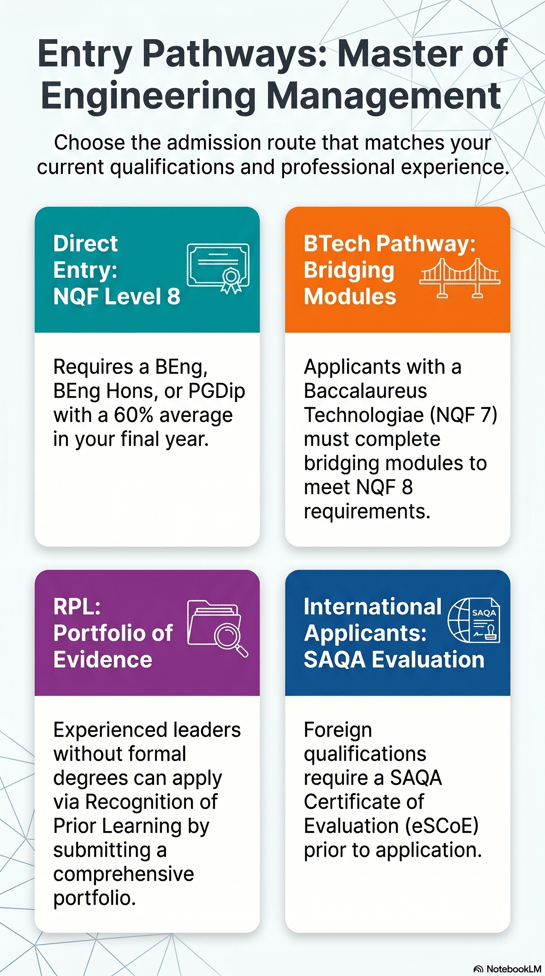
The Higher Education Qualifications Sub-Framework (HEQSF) dictates that standard postgraduate entry into an NQF Level 9 Masters degree requires a prior NQF Level 8 qualification in a related discipline. For the TUT MEM programme, the primary admission pathway requires applicants to hold a relevant engineering degree at NQF Level 8 with a minimum academic average of 60% in their final year of study.
The qualifying benchmarks for entry are detailed below:
- Bachelor of Engineering (BEng): This NQF Level 8 qualification offers a direct pathway into the programme, requiring a minimum academic performance of 60% or more in the final year of study.
- Bachelor of Engineering Honours (BEng Hons): Classified at NQF Level 8, this direct pathway qualification requires candidates to have achieved an academic average of at least 60% in their final year.
- Bachelor of Engineering Technology Honours (BEngTech Hons): At NQF Level 8, this direct-entry qualification requires a final-year academic performance of 60% or more.
- Postgraduate Diploma in Engineering (PGDip Eng): This NQF Level 8 qualification represents a direct pathway and requires a minimum average of 60% in the final year of study.
- Bachelor's Degree in a Cognate Field: Limited to four-year Bachelor’s Degrees at NQF Level 8, applicants with a related qualification require a final-year academic performance of 60% or more. Acceptance through a related field is subject to a departmental review for admission.
This structured pathway accommodates engineering graduates across various disciplines, such as civil, mechanical, chemical, electrical, or industrial engineering, enabling a broad spectrum of technical professionals to transition into management roles.
Alternative pathways: BTech articulation and bridging protocols
Historically, many practising engineering professionals in South Africa qualified with a Baccalaureus Technologiae (BTech) degree, which is positioned at NQF Level 7. To support professional mobility and recognise the immense value of active engineering technologists, TUT provides a clear articulation pathway.
Prospective candidates holding a relevant BTech in an engineering field can be considered for admission into the MEM programme. However, because a BTech does not meet the baseline NQF Level 8 entry requirement, these applicants must successfully complete a prescribed number of formal academic bridging modules. This pathway ensures that BTech holders close any theoretical gaps in research methodology and advanced engineering principles, preparing them for the academic rigour of NQF Level 9 studies while continuing to progress towards registration with professional bodies such as the Engineering Council of South Africa.
Recognition of prior learning
For experienced technical leaders who do not possess the standard formal qualifications, the university operates under a comprehensive Recognition of Prior Learning (RPL) framework. RPL acts as a mechanism for equity and access in the South African higher education landscape, formally validating knowledge gained through professional practice, short courses and in-service training.
Under this policy, applicants can access the programme through RPL for Access. This mechanism requires candidates to submit a comprehensive portfolio of evidence demonstrating that their informal and non-formal learning has equipped them with competencies equivalent to an NQF Level 8 qualification. Additionally, registered students can leverage RPL for Exemption of Modules or RPL for Credit to gain recognition for equivalent competencies, potentially reducing their academic load in specific areas.
International qualification verification
Due to the flexible nature of the online delivery model, the programme is highly accessible to international students and regional African professionals. However, candidates with foreign qualifications must have their credentials formally evaluated by the South African Qualifications Authority before applying, which can be done here.
SAQA's evaluation is a two-phased process that verifies the authenticity of the foreign qualification and compares it with the South African HEQSF to locate its equivalent NQF level. Given that the evaluation process takes approximately three months from the receipt of a compliant application, prospective international students are advised to obtain their electronic Certificate of Evaluation (eSCoE) well in advance of the university's registration closing dates.
Implications for engineering career progression
The online MEM programme is designed to equip technical professionals with the tools they need to navigate modern infrastructure challenges and lead large-scale projects. By understanding and meeting these entry requirements, ambitious engineers can successfully navigate the transition from technical execution to strategic leadership, helping mitigate leadership-induced project failures that often affect the local engineering sector. Eligible candidates can find further details about module fees and enrolment structures directly on the Master of Engineering Management page.
Further reading about the MEM programme
If you would like to find out more about the Master of Engineering Management programme, you can also read the following articles:
- What jobs can you do with an online Master of Engineering Management?
- Step-by-step guide to applying for a Master of Engineering Management
- Tips and support for online Master of Engineering Management students
FAQs: MEM Admission Criteria
1. What is the academic performance threshold for direct entry?
Direct entry into the Master of Engineering Management requires an NQF Level 8 engineering qualification, such as a BEng Honours or a Postgraduate Diploma in Engineering, with an academic average of at least 60% in the final year.
2. Can a candidate with a BTech degree qualify for the online MEM?
Yes, candidates with a relevant BTech in an engineering field can qualify for the programme. However, their admission is subject to the successful completion of prescribed academic bridging modules to bridge the gap between NQF Level 7 and Level 9.
3. How does the RPL process facilitate entry for experienced professionals?
The Recognition of Prior Learning (RPL) pathway allows candidates without standard formal qualifications to submit a portfolio of evidence. This portfolio must document the prior formal, non-formal, and informal learning and professional experience that demonstrates equivalent NQF Level 8 competencies.
4. What is the process for international applicants with foreign engineering degrees?
International applicants must have their foreign degrees verified and compared by the South African Qualifications Authority (SAQA). They must submit their academic credentials to SAQA to obtain an electronic Certificate of Evaluation before applying to TUT. You can go here to learn more about this process.
5. How long does the SAQA foreign qualification evaluation process take?
The standard turnaround time for SAQA to process and issue a foreign qualification evaluation decision is three months from the date they receive a fully compliant application.