0800 233 725 (toll-free)
 enquiries@online.tut.ac.za
%201.png?width=371&height=115&name=logo%20(1)%201.png)

Aspiring and advancing project managers often face a critical decision: should they pursue a project management certification or an advanced diploma? While both options provide valuable knowledge and skills, they differ in industry recognition, career opportunities, cost, and long-term benefits. This article breaks down the key differences between a certification and a diploma in project management and highlights why the Tshwane University of Technology (TUT) Advanced Diploma in Project Management is the best option for career growth.
Covered in this article
Understanding the Differences: Project Management Certification vs Advanced Diploma
Why Choose the TUT Advanced Diploma in Project Management?
Key Benefits of the TUT Advanced Diploma in Project Management
Which One Should You Choose?
Final Thoughts: Invest in Your Future with the Right Qualification
FAQs
Understanding the Differences: Project Management Certification VS Advanced Diploma
Choosing between a project management certification and an advanced diploma depends on your career goals, experience, and learning preferences. Certifications like PMP and PRINCE2 offer industry recognition, while an advanced diploma provides comprehensive, practical knowledge. Understanding the differences in career impact, cost, and long-term benefits will help you decide which option best supports your professional growth.
Project Management Certifications (PMP, PRINCE2, CAPM, etc.)
Project management certifications, such as the Project Management Professional (PMP®), Certified Associate in Project Management (CAPM®), and PRINCE2, are industry-recognised credentials awarded by professional bodies like the Project Management Institute (PMI) and AXELOS. These certifications validate a candidate’s project management knowledge and expertise.
Advantages of Project Management Certifications
- Industry Recognition – Certifications like PMP and PRINCE2 are highly regarded globally.
- Quick Career Boost – They can be earned in a shorter time compared to an advanced diploma.
- Higher Earning Potential – Certified project managers often earn higher salaries.
- Standardised Knowledge – Certifications ensure that you understand best practices in project management.
Limitations of Project Management Certifications
- Experience Required – Many certifications require years of work experience in project management.
- Costly Renewal Fees – Certifications require continuous professional development and renewal fees.
- Focused on Theory, Not Practical Application – They focus more on theoretical frameworks than real-world application.
Project Management Diplomas (Advanced Diploma in Project Management)
A project management advanced diploma provides in-depth education on project planning, execution, risk management, and leadership. Unlike certifications, diplomas cover a broader scope, making them a more comprehensive and practical qualification.
Advantages of a Project Management Advanced Diploma
- Comprehensive Learning – Covers both theoretical frameworks and practical applications.
- No Renewal Fees – Unlike certifications, an advanced diploma is a once-off qualification with lifelong value.
- Career Advancement – Recognised by employers as a formal qualification in project management.
- Pathway to Further Studies – This can eventually lead to a master’s degree in project management.
Limitations of a Project Management Advanced Diploma
- Takes Longer to Complete – Advanced diplomas take time to complete compared to short certification courses.
- Higher Initial Cost – Tuition fees can be higher than certification costs.
Here is a simple and helpful table comparing a Project Management Certification vs Advanced Diploma to help you understand the key differences.
| Feature | Project Management Certification | Project Management Advanced Diploma |
|---|---|---|
| Purpose | Validates project management knowledge and industry standards | Provides in-depth theoretical and practical project management training |
| Recognition | Globally recognised by employers and professional bodies | Recognised as a formal qualification by academic institutions and employers |
| Learning Approach | Focuses on frameworks and methodologies | Covers practical application, leadership, and strategic management |
| Duration | Short-term (weeks to a few months) | Longer-term (months to years) |
| Entry Requirements | Often requires work experience in project management | May require prior qualifications but no work experience needed |
| Cost | Lower initial cost but requires renewal fees | Higher initial cost but no renewal fees |
| Renewal Requirement | Requires continuous education and renewal fees | No renewal is required; once-off qualification |
| Career Impact | Enhances credibility and industry standing | Provides a strong foundation for long-term career growth and leadership roles |
| Flexibility | Self-paced or instructor-led (depends on provider) | Structured, but flexible learning with defined coursework and deadlines |
| Best For | Experienced professionals looking to validate skills | Individuals seeking a full qualification for career advancement |
Why Choose the TUT Advanced Diploma in Project Management?
The Tshwane University of Technology (TUT) Advanced Diploma in Project Management is designed for professionals who want to gain practical, real-world skills and academic recognition in the field. Unlike short-term certifications, this advanced diploma provides a strong theoretical foundation combined with hands-on project management experience. It equips students with the knowledge and tools required to manage complex projects, make strategic decisions, and lead teams effectively.
For those looking to establish a long-term career in project management, this advanced diploma offers several key advantages:
1. Practical and Theoretical Knowledge
The programme combines academic principles with real-world application, ensuring students understand project planning, execution, risk management, and leadership. Unlike certifications that focus mostly on theoretical frameworks, this advanced diploma provides a holistic understanding of project management in practice.
2. Recognised Qualification
An advanced diploma from Tshwane University of Technology (TUT) is highly valued by employers. It demonstrates a formal education in project management, which can be a key requirement for promotions and managerial positions.
3. Long-Term Career Growth
An advanced diploma opens doors to leadership roles, making it easier for graduates to transition into senior project management and strategic positions. It also serves as a stepping stone for further studies, such as a master’s degree in project management.
4. No Renewal Fees
Unlike PMP, PRINCE2, and other certifications that require continuous renewals and maintenance fees, the TUT advanced diploma is a once-off qualification with lifelong value. This makes it a cost-effective option for those looking for a recognised project management credential.
5. Pathway to Further Studies
For those who want to continue their academic journey, this advanced diploma provides a direct pathway to postgraduate qualifications, including a master’s degree in project management. This makes it an excellent option for professionals who aim to specialise further in the field.
Key Benefits of the TUT Advanced Diploma in Project Management
The TUT Advanced Diploma in Project Management offers a practical and theoretical foundation for career growth. Unlike certifications, it provides long-term value, recognised qualifications, and hands-on learning. With no renewal fees and a pathway to further studies, this advanced diploma is ideal for those seeking career stability, leadership roles, and advancement in project management.
- Practical and Theoretical Knowledge – Unlike certifications, the programme combines academic depth with hands-on learning, ensuring graduates are work-ready.
- Recognised Qualification – A formal advanced diploma from Tshwane University of Technology (TUT) is highly valued by employers.
- Long-Term Career Growth – An advanced diploma opens doors to managerial roles and further studies in Master’s programmes.
- No Need for Renewal – Unlike PMP or PRINCE2, this qualification does not require ongoing renewal fees or re-examinations.
Which One Should You Choose?
The best choice depends on career goals, experience level, and long-term aspirations.
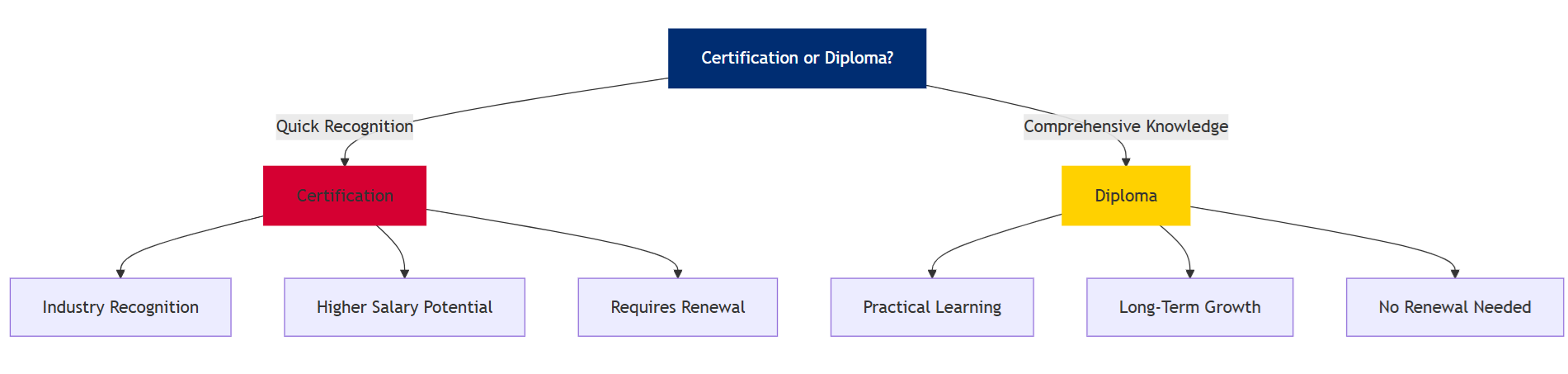
- If you need quick recognition and already have project management experience, a certification like PMP or PRINCE2 might be a good option.
- If you are looking for comprehensive knowledge, career progression, and long-term value, an Advanced Diploma in Project Management from TUT is the better choice.
The decision diagram below helps aspiring project managers choose between a project management certification and an advanced diploma:
Final Thoughts: Invest in Your Future with the Right Qualification
When comparing project management certification vs an advanced diploma, it is clear that certifications are great for validation, but a diploma offers long-term career value.
With the TUT Advanced Diploma in Project Management, students gain practical, real-world experience, a recognised qualification, and a solid foundation for future career growth.
Find out more about the TUT Advanced Diploma in Project Management today.
FAQs: Project Management Certification vs Diploma
1. Can I pursue both a project management certification and an advanced diploma?
Yes, many professionals start with an advanced diploma to gain foundational knowledge and later pursue a certification like PMP or PRINCE2 for industry recognition.
2. Does a project management advanced diploma qualify me for global job opportunities?
An advanced diploma from an accredited institution like TUT is recognised in many industries worldwide. However, certifications like PMP may be required for specific roles.
3. How do employers view an advanced diploma compared to a certification?
Employers value advanced diplomas for their depth of study and practical application, while certifications demonstrate knowledge of industry best practices and methodologies.
4. What are the academic entry requirements for a project management advanced diploma?
Entry requirements vary by institution, but most advanced diplomas require a prior qualification, such as a higher certificate or relevant work experience.
5. Will a project management advanced diploma allow me to specialise in a specific industry?
Yes, an advanced diploma covers project management principles that can be applied across industries, but some programmes offer industry-specific electives.
6. Do I need work experience to enrol in a project management advanced diploma?
Not always. Some institutions accept students without experience, while others require prior work in project management or a related field.
7. Is online learning available for project management advanced diplomas?
Yes, institutions like TUT offer online learning, allowing students to study while working. This provides flexibility without compromising quality.
8. How does an advanced diploma help in transitioning to a leadership role?
An advanced diploma equips students with strategic management, risk assessment, and leadership skills, preparing them for managerial positions in project-based roles.
9. Will a project management advanced diploma improve my chances of earning a master's degree?
Yes, an advanced diploma can serve as a stepping stone toward a master’s programme, making it a valuable option for career progression.
10. How do I choose the best advanced diploma programme for my career goals?
Look for accreditation, curriculum content, industry partnerships, and whether the programme aligns with your professional aspirations.