0800 233 725 (toll-free)
 enquiries@online.tut.ac.za
%201.png?width=371&height=115&name=logo%20(1)%201.png)

The wholesale and retail sector serves as a vital pillar of the South African economy, yet the Wholesale and Retail Sector Education and Training Authority continuously highlights a critical shortage of qualified managerial skills within the industry. To address these industry-specific challenges, TUT provides a specialised Diploma in Retail Business Management. The fully online qualification has been designed specifically for working professionals, offering a highly flexible structure with multiple intake cycles throughout the academic year to accommodate demanding work schedules. Read on to learn how the online application process works.
Pre-Application: Verify Your Eligibility
Before beginning the application process, applicants must ensure they meet the specific entry criteria for the programme. To qualify for this NQF Level 6 qualification, candidates typically require a National Senior Certificate (NSC) or equivalent qualification with an endorsement for diploma studies. Candidates must also meet the minimum Admission Point Score (APS) and specific subject prerequisites (such as English proficiency and mathematics or mathematical literacy). Candidates can verify their exact academic eligibility during their initial consultation with an advisor.
Step-by-Step Application Process
The digital enrolment ecosystem of the university is designed to offer a supportive, high-touch experience that minimises administrative barriers for distance learners.
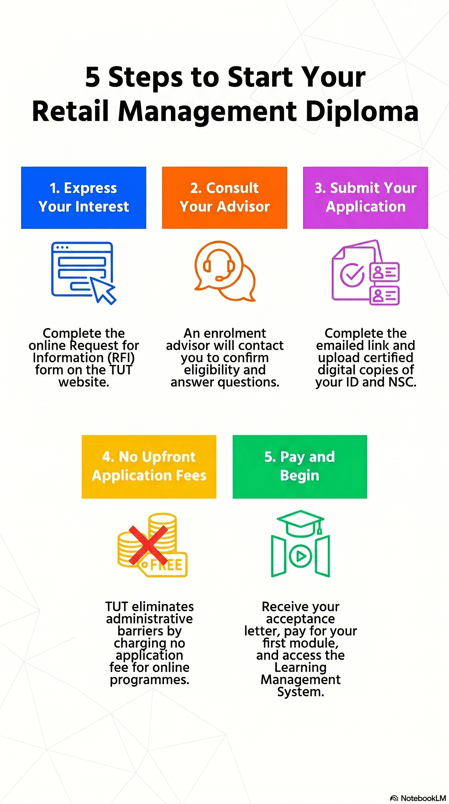
- Step 1: Express Your Interest: Complete the Request for Information (RFI) form, which can be found here on the online subdomain of the TUT website.
- Step 2: Personal Consultation: A friendly enrolment advisor will contact you to discuss your chosen programme, help confirm your eligibility, and answer questions about online learning.
- Step 3: Complete Your Application: If you qualify, you will receive an application link via email. Fill out the application form accurately and upload your supporting documents.
- Step 4: Application Review: TUT’s dedicated admissions team will carefully evaluate your application and supporting documentation.
- Step 5: Welcome to TUT: Once accepted, you will receive an official acceptance letter and student number via email. This student number enables you to make the flexible payment for your first module. Once paid, you will receive your credentials to access the Learning Management System (LMS) and begin your lectures.
There is no application fee for TUT online programmes, making it easier for students to access higher education without upfront administrative costs.
Preparing Your Supporting Documents
To avoid administrative delays, you should gather and prepare clear digital copies of your supporting documents in advance. These must be officially certified at an authorised facility, such as a South African Police Service (SAPS) station or by a Commissioner of Oaths, within the last three months:
- Proof of Identity: A certified copy of your South African Identity Document or national passport.
- Academic Matriculation: A certified copy of your National Senior Certificate (NSC) or equivalent matric results.
- Tertiary Academic Record: Official transcripts and NQF certificates from previous higher education institutions (required if you seek credit exemptions or recognition of prior learning).
All files must be formatted correctly (typically as legible PDFs) and uploaded using the secure link provided to you.
Read more about the programme
If you would like to find out more about the Diploma in Retail Business Management programme, you can also read the following articles:
- What jobs can you do with a Diploma in Retail Business Management?
- Do you qualify for an online Diploma in Retail Business Management?
- Tips for workers studying TUT's Diploma in Retail Business Management
FAQs: DRBM Entry Requirements
1. Is there an application fee for the online Diploma in Retail Business Management?
No, TUT does not charge an application fee for online students. This is a major advantage for distance learners, as payment is only required per module once you are accepted.
2. How do I get the official online application link?
The application link is sent directly to your email once you have completed the Request for Information (RFI) form and your eligibility has been confirmed during your personal consultation with a TUT online advisor.
3. Where can South African applicants have their supporting documents certified?
You can get your academic records and identification documents certified for free at any South African Police Service (SAPS) station, post office, or through a registered Commissioner of Oaths.
4. How are updates on my application communicated?
TUT communicates all progress updates, further requirements, and official admission offers electronically via email. It is crucial to monitor your inbox and spam folders regularly to ensure you do not miss these updates.
5. What happens after my application is approved?
Once your application is successful, you will receive an official acceptance letter containing your student number. You will use this number to pay for your first module, after which you will receive your credentials to access the online Learning Management System (LMS).